

This article is part of a series of posts that will compare each card in the Tarot across different decks in order to study and explore each archetype and concept more deeply. This is not necessarily meant to be a teaching tool for others, but if you like to study the Tarot as much as I do, I hope you find it interesting. Enjoy!
For more on the decks referenced here please another page in my blog: Tools of the Locksmith: https://wordpress.com/page/theramblinglocksmith.com/163
A major reference for this study was “Seventy-Eight Degrees of Wisdom” by Rachel Pollack.
This week we meet The Hermit who is both an example and a guide to teach us how to be ok with ourselves and activate our unconscious mind.
The Hermit is alone on purpose but they are here to show us the way to begin our own process of being along on purpose. This includes understanding the difference between withdrawing from society for a time in order to learn what we need to learn about ourselves versus a complete withdrawal from humanity. When you withdraw from society you can be on a visionary or spiritual quest to discover new knowledge within yourself, but your intention is always to bring that knowledge back to teach others. Isolating yourself from humanity is usually a response to trauma. It means you are dissociated and disconnected, and in this state you cannot access the knowledge of the Hermit. Learning the difference is tricky, but simply going on a silence retreat may not give you the answers you need if you still need to have a conversation with yourself and any hurting parts first.
Standard elements of the Hermit card include:
- A lantern of knowledge to help light the way for yourself and others
- No landscape behind no other objects but the Hermit and his lamp to show the extent of isolation necessary to learn to activate the unconscious mind
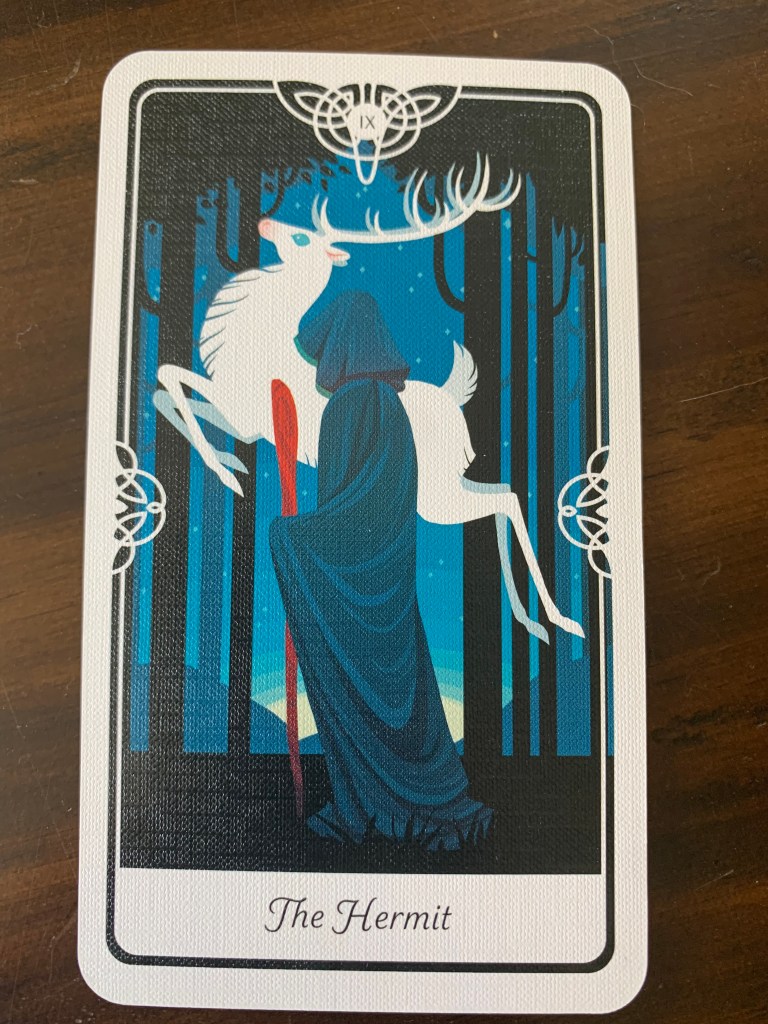
The Tarot of the Divine chooses to illustrate the archetype of the Hermit through the Celtic Legend of the Druid and the White Stag.
There were many different kinds of druids, but it took many years of study to become a full druid no matter if you were a bard, legal authority, lore-keeper, or medicine person. Many of these studies were quests, and the white stag heralded the beginning of a quest.
How can we relate to this back to the Hermit and how can we relate to this ourselves? I think in two ways.
First by understanding that when we are alone we aren’t really alone if we are still connected to humanity and our own spirituality. The “White Stag” is always with us waiting to show us the way to our next quest.
The second is by undrstanding that we retreat to learn many ways of becoming our deeper selves, not just our deeper spiritual selves. Maybe you need this to become a better artist or story teller. Maybe you need the pause to learn a different medicine that you can bring back to help heal yourself and others.
Take the pause for whatever reason you need, and then come back and teach it to others.

The Ancestral Path Tarot we see a traditional looking hermit type of guy, but he has a couple of extra things, and only the extra things he needs:
- He has a view of the waves that crash on the shore. Why? because he can detach and observe his emotional self from a different perspective using solitude. Its easier to do that than from solitude.
- He has a star to give him hope, so its not a hopeless solitude. Its the opposite. It has a higher purpose.
- He has his own medicine that is borne of that hope so that now he can bring hope to others.
What is the medicine or story of hope that you can bring to others? Find your own solitude and learn this. How can you help others connect to that hope? You may need to create or find a quiet place to detach from your emotions to do this.

In the Santa Muerte Tarot we see a fella that seems to be in dire consequences. There is a caterpillar that seems to be feasting on him and some other insects. He has a flask at his feet – was this what put him in such dire consequences? What is the story here and how is it one of inner reflection and hope that connects us back to humanity. I mean at least he has a lantern?
Well that all depends on your perspective I guess. Maybe he took this spot of solitude to leave the flask behind. Maybe he realizes what his poison is and he is in the process of transcending it, and the insects are his rebirth. He still holds the lantern and its still lit. If he overcomes this he has much to teach others about resilience and never giving up.
What are you trying to overcome? Does it feel like something that is insurmountable? Take the pause. Understand what the poison is. Leave it behind. Keep the lantern lit. Come back and teach others.

In the Light Seers Tarot we finally get our female Hermit. She has not only transcended the lantern and become her own light, but she has transcended one kind of path and can see many other kinds of paths. This is a treasured outcome that might seem hard for most of us to achieve.
Take one step toward your own hermitage and understand where your own light comes from. Once you can understand the source of this you can understand how to grow it. Before you know it you will be floating giving you a great view of other paths.
Help others find the source of their own light. Become a lightworker. Lightworkers are our earthly hermits.

In the Way Home Tarot our friend the bear is in hibernation. I don’t think hibernation is what we are going for here exactly, but sometimes we have to start somewhere. He has a tiny light around his collar. He remembers the sun of spring and summer. This will get him through the hibernation of winter.
If this is you and you are in a kind of hibernation focus on a few things. Why did you go into hibernation in the first place? Was it instinctual? Remind yourself of what will be present that will tell you to come back into a stronger awareness. Look for that memory of Spring of Summer and that light. Commit to coming out of hibernation when the time is right.

The Osho Zen Tarot is like one of those assholes that is always right. I mean really.
Ok… the Hermit here is represented by a “humble figure” who lights his own path with his own light. Great. How do we do that?
First answer is by leaving behind the requirement to have others approve the truth you are finding in yourself. Leave any maps or guides that have been given to you behind and find your way.
But if we dig a little deeper the way to understand how to do that is to be humble. When we are humble our intentions are true and clear and not weighted down with the intentions that others have for us.
If we are humble we have found our own light, and it is only then that we are truly connected and not alone. We find connection through correct “aloneness”. And that is the magic and secret of the Hermit.
Be well.




 The Rambling Locksmith
You must be logged in to post a comment.